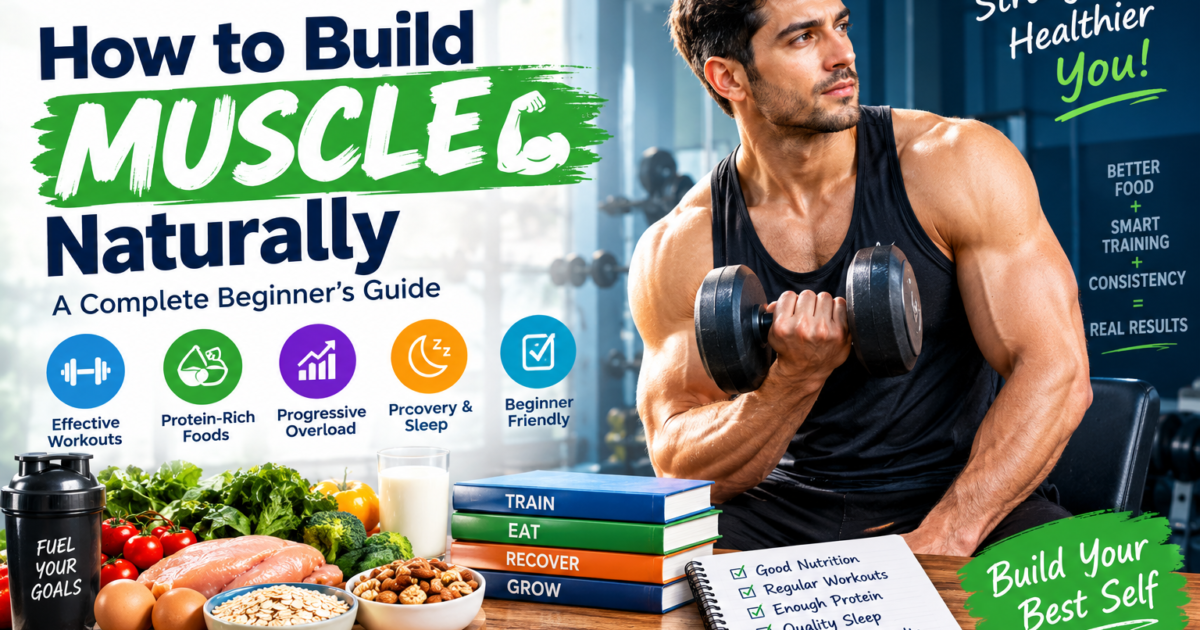
How to Build Muscle Naturally: A Complete Beginner’s Guide
Building muscle takes more than lifting heavy weights. You need a consistent workout routine, enough protein, nutritious food, proper recovery, and a plan you can follow for months—not just a few days.
Whether you train at home or in a gym, this guide will help you understand how muscle growth works, how much protein you need, which foods to eat, and how to create a practical muscle-building routine.
What Is Muscle Building?
Muscle building, also known as muscle hypertrophy, is the process of increasing the size of your skeletal muscles. Resistance training challenges your muscles, and your body adapts by repairing and building muscle tissue.
Three important factors support this process:
- Progressive resistance training: Gradually increasing the challenge of your workouts.
- Proper nutrition: Eating enough protein, calories, carbohydrates, and healthy fats.
- Recovery: Giving your muscles time to recover between demanding workouts.
Consistency matters more than following a complicated routine. Beginners can often make meaningful progress with a relatively simple training program.
1. How Much Protein Do You Need to Build Muscle?
Protein provides amino acids that help your body repair and build muscle tissue. Eating enough protein is especially important when you regularly perform resistance training.
According to the International Society of Sports Nutrition, approximately 1.4–2.0 grams of protein per kilogram of body weight per day is sufficient for most healthy, exercising individuals. Your ideal intake depends on your training, diet, goals, and individual circumstances.
Calculate Your Daily Protein Requirement
Use this simple formula:
Daily protein target = Body weight in kilograms × Protein target per kilogram
For example, if you weigh 70 kg and choose a target of 1.6 grams per kilogram:
70 × 1.6 = 112 grams of protein per day
Here are some example targets using 1.6 grams per kilogram:
| Body Weight | Daily Protein Target |
|---|---|
| 50 kg | 80 g |
| 60 kg | 96 g |
| 70 kg | 112 g |
| 80 kg | 128 g |
| 90 kg | 144 g |
| 100 kg | 160 g |
These are examples, not mandatory targets for everyone. People with significant excess body fat may need a different calculation approach. Those with kidney disease or other relevant medical conditions should seek individualized medical advice before substantially increasing protein intake.
For more personalized guidance, use the Protein Calculator at ProteinCalculator.io to estimate your daily protein needs.
2. Best Muscle-Building Foods in Pakistan
You do not need expensive supplements or imported foods to build muscle. Many affordable foods commonly available in Pakistan can help you meet your nutritional needs.
High-Protein Animal Foods
- Eggs: Convenient sources of protein and other nutrients.
- Chicken: A versatile, protein-rich option for lunch or dinner.
- Fish: Provides protein, and oily fish can also supply omega-3 fats.
- Milk: Contains protein, carbohydrates, and calcium.
- Plain yogurt (dahi): Provides protein and can be included in meals or snacks.
- Lean beef or mutton: Supplies protein, iron, and vitamin B12.
Plant-Based Protein Sources
- Daal: Lentils are affordable and provide protein, carbohydrates, and fiber.
- Chickpeas (chana): Useful for meals and snacks.
- Beans: Offer protein, fiber, and other nutrients.
- Soy foods: Tofu and other soy products can provide substantial protein.
- Peanuts: Supply some protein along with fats and calories.
Rice, roti, potatoes, oats, and fruit are also useful parts of a muscle-building diet because they provide energy for training and everyday activities.
Practical tip: Combine different protein sources throughout the day. A varied diet makes it easier to obtain the amino acids and other nutrients your body needs.
3. Do You Need a Calorie Surplus to Build Muscle?
Calories provide the energy your body needs to function, exercise, and recover.
If your main goal is to gain muscle size, eating a modest amount above your daily energy needs can help support growth. However, a large calorie surplus is not necessary and can lead to unwanted fat gain.
Your approach depends on your starting point:
- Naturally lean beginners: A small calorie surplus may help support muscle growth.
- People with significant excess body fat: Building muscle while gradually reducing fat may be possible, especially when beginning resistance training.
- Experienced lifters: Progress may require more careful adjustments to calorie intake and training.
Monitor your body weight, waist measurement, workout performance, and progress photos over several weeks. Adjust food intake based on your results rather than relying on a single day’s weight.
4. A Simple Weekly Workout Plan for Beginners
Beginners can build muscle by training all major muscle groups regularly and gradually increasing the challenge. The following three-day full-body plan is a practical starting point for healthy adults.
Monday — Full Body Workout A
| Exercise | Sets | Repetitions |
|---|---|---|
| Squats or goblet squats | 3 | 8–12 |
| Push-ups or chest press | 3 | 8–12 |
| Dumbbell or cable rows | 3 | 8–12 |
| Romanian deadlifts with light weights | 2 | 8–12 |
| Plank | 2 | 20–45 seconds |
Wednesday — Full Body Workout B
| Exercise | Sets | Repetitions |
|---|---|---|
| Lunges or split squats | 3 | 8–12 per leg |
| Overhead shoulder press | 3 | 8–12 |
| Lat pulldown or assisted pull-ups | 3 | 8–12 |
| Glute bridges | 3 | 10–15 |
| Biceps curls | 2 | 10–15 |
Friday — Full Body Workout A
Repeat Monday’s routine. The following week, alternate the order if desired so that Workout B is performed twice.
On other days, take walks, perform light activity, or rest as needed.
Important: Start with manageable resistance and learn correct technique. Choose a weight that allows you to complete your repetitions with control. Stop if you experience sharp pain, and seek qualified guidance if you are unsure how to perform an exercise safely.
This is a starting template, not a universal prescription. Your training history, available equipment, mobility, and recovery capacity may require adjustments.
5. Progressive Overload: The Key to Continued Progress
Your muscles adapt to training over time. If your workouts never become more challenging, your progress may eventually slow.
Progressive overload means gradually increasing the training stimulus as your ability improves.
You can apply it by:
- Increasing the weight slightly while maintaining good form.
- Performing more repetitions with the same weight.
- Adding a set when appropriate.
- Improving movement control and range of motion.
- Using a more challenging variation once you have mastered the current one.
For example, suppose you perform three sets of 10 push-ups with good technique. Over time, you might work toward three sets of 12. Once that becomes manageable, you can consider a harder variation.
Keep a workout log with your exercises, weights, repetitions, and sets. This helps you see whether you are progressing instead of guessing.
Avoid increasing weight so quickly that your technique deteriorates.
6. How Many Repetitions and Sets Should You Do?
There is no single repetition range that guarantees muscle growth.
Many beginners can start with approximately 2–3 sets per exercise and 8–12 repetitions per set. Other repetition ranges can also build muscle when the exercise is performed with appropriate effort and technique.
For continued progress, training volume matters. The 2026 American College of Sports Medicine position stand reports that higher weekly training volumes—around 10 or more sets per muscle group—can support greater muscle growth for many adults.
However, beginners should not immediately jump into high-volume training. Start with a manageable workload and gradually increase it as your technique and recovery improve.
You also do not need to take every set to complete muscular failure. Finishing a set with a small number of good-quality repetitions still possible can be an effective approach for many people.
7. Why Sleep and Recovery Matter
Muscle growth does not happen only while you are lifting weights. Recovery helps your body adapt to the training stimulus.
To support recovery:
- Aim for 7–9 hours of sleep per night if you are an adult.
- Allow adequate recovery between demanding sessions for the same muscles.
- Eat enough total food and protein.
- Drink water regularly, especially during hot weather and exercise.
- Manage training fatigue rather than pushing through every workout.
Feeling sore is not proof that a workout was successful. You can make progress without being extremely sore after every session.
If you consistently feel exhausted, your performance declines, or your joints hurt, review your training volume, technique, sleep, and nutrition.
8. Do You Need Whey Protein for Muscle Growth?
No. Whey protein is a convenient supplement, not a requirement for building muscle.
You can obtain your daily protein from ordinary foods such as eggs, chicken, fish, milk, yogurt, lentils, beans, and soy products.
Whey protein may be useful when your regular meals do not provide enough protein or when you need a quick option after training.
If you choose a supplement, buy from a reputable seller, check the ingredient list, and look for appropriate independent quality testing where available. Supplements cannot replace a balanced diet or a consistent training program.
Avoid products that promise extremely rapid muscle growth or contain undisclosed ingredients.
People with milk allergies should avoid milk-derived whey products. Those with kidney disease or other relevant medical conditions should consult a healthcare professional before making substantial dietary or supplement changes.
9. Sample Daily Muscle-Building Meal Plan
Here is an example of how someone in Pakistan might organize a day of eating.
Breakfast
- Eggs
- Whole-wheat roti or oats
- Milk or plain yogurt
- One serving of fruit
Lunch
- Chicken, fish, daal, or beans
- Roti or rice
- Seasonal vegetables or salad
Afternoon Snack
- Yogurt or milk
- Fruit or a small serving of nuts
Dinner
- Chicken, fish, lean meat, daal, or another protein source
- Roti or rice
- Cooked vegetables or salad
Optional Evening Snack
- Milk, yogurt, or another suitable protein-rich food if needed to meet your daily target
This is a flexible example, not a fixed calorie prescription. Portion sizes should reflect your body size, activity, appetite, budget, and goals. Vegetarian options can work well when you combine suitable protein sources and eat enough overall.
10. Common Muscle-Building Mistakes to Avoid
Mistake 1: Changing Workouts Every Week
Constantly switching exercises makes it harder to track progress. Keep a reasonably consistent program long enough to improve your performance.
Mistake 2: Ignoring Protein Intake
Training alone may not produce the results you want if your diet consistently lacks adequate protein and energy.
Mistake 3: Eating Too Much Junk Food
A calorie surplus does not mean you should eat unlimited fast food or sugary snacks. Prioritize nutritious meals and use flexible food choices that fit your needs.
Mistake 4: Lifting More Weight Than You Can Control
Poor technique increases the risk of injury. Good-quality repetitions are more useful than showing off with excessive weight.
Mistake 5: Neglecting Legs and Other Muscle Groups
A balanced program should train the legs, back, chest, shoulders, arms, and trunk rather than focusing exclusively on visible muscles.
Mistake 6: Expecting Overnight Results
Muscle growth is gradual. Progress depends on consistency, training experience, genetics, nutrition, recovery, and many other factors.
Mistake 7: Relying on Supplements Instead of Fundamentals
Protein powder and other supplements cannot compensate for an ineffective training plan, inadequate sleep, or poor overall nutrition.
11. How Long Does It Take to Build Muscle?
There is no exact timeline that applies to everyone.
Beginners may notice improvements in exercise technique and strength within the first several weeks. Visible changes in muscle size generally require more time and consistent training.
Your results will depend on factors such as:
- Your starting fitness level
- Your workout consistency
- Your daily protein and calorie intake
- Sleep and recovery
- Age, genetics, and health
- The quality and progression of your training
Take progress photos under similar lighting every four weeks, record your workouts, and monitor your body weight over time. These methods can provide a clearer picture than checking the mirror every day.
Focus on sustainable improvement rather than comparing your body with edited social media photos.
12. Your First 30 Days of Muscle Building
Use this simple checklist to get started.
Week 1: Build the foundation
- Learn correct exercise technique.
- Start with manageable weights.
- Establish a consistent meal and sleep routine.
Week 2: Improve consistency
- Complete your planned workouts.
- Include a protein source in your main meals.
- Record your exercises and repetitions.
Week 3: Look for small improvements
- Add repetitions or a small amount of weight when appropriate.
- Review whether you are eating enough.
- Keep your recovery routine consistent.
Week 4: Review and adjust
- Compare your workout records.
- Check your weight trend and progress photos.
- Adjust your food portions or training plan if necessary.
- Set a realistic goal for the next month.
The goal of your first month is to establish habits and learn how to train safely—not to transform your body overnight.
Frequently Asked Questions
Can beginners build muscle without supplements?
Yes. Beginners can build muscle through appropriate resistance training, adequate nutrition, sufficient protein, and recovery. Supplements are optional.
Is it possible to build muscle at home?
Yes. Bodyweight exercises, resistance bands, and dumbbells can provide an effective training stimulus. Increase the difficulty gradually as you become stronger.
How much protein should I eat to build muscle?
Many healthy adults who exercise regularly can start by considering approximately 1.4–2.0 grams of protein per kilogram of body weight per day. Individual requirements vary.
Should I work out every day?
Not necessarily. A well-planned routine with sufficient recovery can be effective without hard training every day. Beginners often do well starting with three full-body sessions per week.
Can I lose fat and build muscle at the same time?
It can be possible, particularly for beginners and people returning to training. Results depend on starting body composition, nutrition, training experience, and recovery.
Do I need to eat immediately after a workout?
You do not need to rush to consume a shake the moment you finish. Getting enough total protein throughout the day is important, and a protein-containing meal before or after training can be practical.
What is the best exercise for muscle growth?
There is no single best exercise for every person. Choose effective movements that target the muscles you want to develop, suit your abilities, and allow you to progress safely.
Final Thoughts
Building muscle naturally is a long-term process, but it does not have to be complicated. Follow a consistent resistance-training plan, eat enough protein and nutritious food, gradually increase the challenge of your workouts, and prioritize sleep and recovery.
Start with small, repeatable habits. Track your progress, adjust your plan when needed, and give your body time to adapt.
Ready to plan your nutrition? Visit ProteinCalculator.io and use the protein calculator to estimate your daily protein needs as part of your muscle-building journey.
Medical Disclaimer
This article is for general educational purposes and is not a substitute for individualized medical or nutritional advice. Exercise safely and seek advice from a qualified healthcare professional or registered dietitian if you have a medical condition, an injury, or special dietary needs.
References
- International Society of Sports Nutrition. Position Stand: Protein and Exercise. Read the research
- American College of Sports Medicine. Resistance Training Prescription for Muscle Function, Hypertrophy, and Physical Performance in Healthy Adults (2026). Read the research
- Centers for Disease Control and Prevention. Adult Physical Activity Guidelines. Read the guidelines