Protein Basics
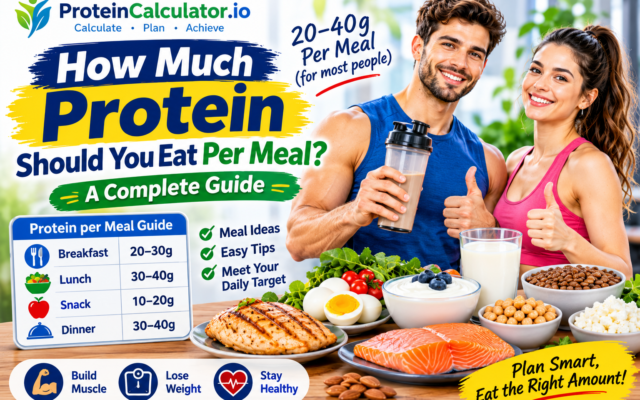
How Much Protein Should You Eat Per Meal? A Complete Guide
How Much Protein Should You Eat Per Meal? A Complete Guide Protein is one of the most important…
Free • Science-based • No sign-up
Find out exactly how much protein you need per day — personalised for your body, activity level and goal, with a per-meal split and food plan.
Your results will appear here
This calculator gives an educational estimate, not medical advice. If you have kidney disease, are pregnant or have a medical condition, check with a doctor or registered dietitian.
General ranges in grams of protein per kilogram of body weight (g/kg) used by the calculator.
Inactive adult
0.8–1.0 g/kg
The RDA minimum to avoid deficiency.
Active / fitness
1.2–1.6 g/kg
Regular exercise, recovery and general health.
Building muscle
1.6–2.2 g/kg
Resistance training with a calorie surplus.
Losing fat
1.6–2.4 g/kg
Protects muscle and controls hunger in a deficit.
Adults 65+
1.0–1.2+ g/kg
Helps slow age-related muscle loss.
Pregnancy (2nd–3rd tri.)
1.1+ g/kg
About +25 g/day over normal needs.
Age, sex, height, weight and how active you are. Add body fat % for an even more accurate, lean-mass-based result.
Fat loss, maintenance, muscle gain or recomposition — each uses ranges from sports-nutrition research (ISSN, ACSM).
See protein per meal, calories, food equivalents, and build a day of meals with the planner until you hit your target.
How Much Protein Should You Eat Per Meal? A Complete Guide Protein is one of the most important…
How Much Protein Do I Need? Use a Protein Calculator to Find Your Daily Intake Are you wondering,…
How Much Protein Should I Eat a Day? A Complete Daily Protein Guide Have you ever wondered, how…
Protein Calculator: How Much Protein Do You Need Daily? Want to know how much protein your body needs…
20 Best High-Protein Foods to Add to Your Daily Diet Protein is one of the most important nutrients…
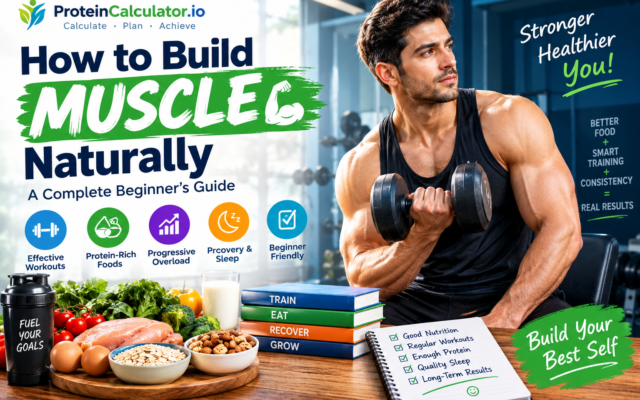
How to Build Muscle Naturally: A Complete Beginner’s Guide Building muscle takes more than lifting heavy weights. You…
The minimum for healthy, inactive adults (the RDA) is 0.8 g per kg of body weight. Most people who exercise, are losing weight or are over 65 do better with 1.2–2.0 g/kg. Use the calculator above for a target matched to your body, activity and goal.
Research reviews point to about 1.6 g per kg of body weight per day as the point where most of the muscle-building benefit is reached, with up to 2.2 g/kg for people who want to cover individual variation. Spread it across 3–5 meals of roughly 0.4 g/kg each.
Yes. In a calorie deficit, a higher intake of about 1.6–2.4 g/kg helps you keep muscle while losing fat, and protein is the most filling macronutrient, which makes dieting easier.
For healthy people, intakes up to around 2.0–2.5 g/kg per day are considered safe in studies. People with chronic kidney disease or other medical conditions should follow their doctor's advice, as they may need to limit protein.
It is optional. If you know it, the calculator bases your target on lean body mass, which gives a more accurate number for people with higher body fat. Without it, people with a BMI of 30 or more get an adjusted body weight so the target is not overestimated.
Yes. Lentils, chickpeas, beans, tofu, tempeh, soy chunks, seitan, dairy and eggs (for vegetarians) can easily cover your needs. Plant proteins are slightly less digestible, so aiming about 10% higher than your target is a sensible buffer.