Protein Calculator: How Much Protein Do You Need Daily?
Want to know how much protein your body needs every day? A protein calculator can help you estimate your daily protein requirement based on your body weight, activity level, fitness goals, and other personal factors. Whether you want to build muscle, lose weight, maintain your current weight, or simply eat a balanced diet, understanding your protein needs is an important step toward better nutrition.
Use the protein calculator on ProteinCalculator.io to get a personalized starting estimate, then follow this guide to understand your results and learn how to meet your daily protein target with everyday foods.
What Is a Protein Calculator?
A protein calculator is an online nutrition tool that estimates how much protein you should consume each day. It uses information such as your body weight, activity level, and fitness goal to provide a daily protein target.
Protein is an essential nutrient that helps your body build and repair muscles, maintain tissues, produce enzymes, and support many normal body functions.
Your protein needs are not the same as everyone else’s. Someone who exercises regularly may need more protein than someone who is mostly sedentary. A person trying to build muscle may also have different needs from someone simply maintaining their current weight.
A protein calculator makes it easier to estimate your needs without manually working through the calculations.
How to Use a Protein Calculator
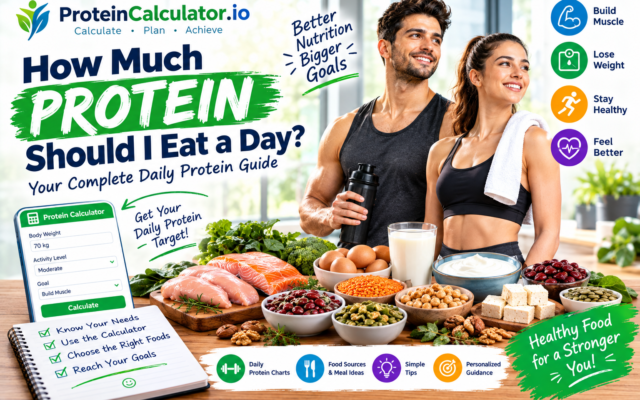
Follow these simple steps to estimate your daily protein requirement.
- Enter your body weight: Choose kilograms or pounds, depending on the calculator’s available settings.
- Select your activity level: Consider whether you are sedentary, moderately active, or highly active.
- Choose your fitness goal: Your goal might be muscle building, weight loss, or general health, depending on the options provided.
- Calculate your protein needs: Use the calculator to obtain your estimated daily target.
- Plan your meals: Distribute protein across meals and snacks using foods you enjoy.
Remember that the result is an estimate, not a medical diagnosis or an exact requirement. Your age, overall diet, health status, training routine, and other factors may affect your individual needs.
How Much Protein Do You Need Per Day?
Your daily protein requirement depends on your body weight, age, activity level, and goals.
For many healthy adults, the general recommended dietary allowance is approximately 0.8 grams of protein per kilogram of body weight per day. People who exercise regularly or train to build muscle may benefit from higher amounts.
The following table provides general examples for healthy adults.
| Body weight | Basic daily reference at 0.8 g/kg |
|---|---|
| 50 kg | 40 g |
| 60 kg | 48 g |
| 70 kg | 56 g |
| 80 kg | 64 g |
| 90 kg | 72 g |
| 100 kg | 80 g |
These figures are general reference amounts, not universal targets for every fitness goal.
Protein Needs by Fitness Goal
For general health: Approximately 0.8 g/kg/day is a commonly used reference for healthy adults.
For regular exercise: Your needs may be higher, depending on exercise intensity, duration, and recovery demands.
For muscle building: Many exercising adults can benefit from approximately 1.4–2.0 g/kg/day when combined with suitable resistance training and adequate overall nutrition.
For weight loss: Protein can help support muscle retention and make meals more satisfying. The appropriate amount depends on your weight, activity level, calorie intake, and health status.
For example, a healthy, active adult weighing 70 kg who is working to build muscle might consider a starting range of roughly 98–140 grams per day. This is an illustrative range, not a recommendation for every 70 kg adult.
If you have kidney disease or another medical condition that affects protein intake, consult a qualified healthcare professional before significantly increasing your protein consumption.
Protein Calculator for Muscle Building
If your goal is to build muscle, protein is an important part of your nutrition plan. Your body uses protein to repair and maintain muscle tissue after exercise.
However, eating more protein alone will not automatically make your muscles grow. Muscle development also requires appropriate resistance training, sufficient calories, sleep, and recovery.
To support muscle growth:
- Eat protein-rich foods throughout the day.
- Follow a consistent resistance-training program.
- Increase training difficulty gradually as your strength improves.
- Consume enough total calories to support your training goals.
- Get sufficient sleep and allow muscles time to recover.
Good protein sources include eggs, chicken, fish, milk, yogurt, lentils, beans, tofu, and other soy products.
For many healthy adults who train regularly, a daily intake around 1.4–2.0 g/kg may be a useful starting range. Your ideal target depends on your training and individual circumstances.
Protein Calculator for Weight Loss
Protein can also play a useful role in a weight-loss plan.
Protein-rich foods can help you feel satisfied after meals. Eating enough protein while losing weight may also help preserve lean muscle, particularly when combined with resistance exercise.
For sustainable weight loss, focus on your overall eating pattern rather than protein alone.
Helpful strategies include:
- Include a protein source in each main meal.
- Eat vegetables, fruits, and other fiber-rich foods.
- Choose appropriate portions based on your energy needs.
- Include regular physical activity.
- Avoid extreme diets that eliminate entire food groups unnecessarily.
For example, you could have eggs and whole-grain toast for breakfast, lentils with vegetables for lunch, yogurt as a snack, and chicken or beans with rice and vegetables for dinner.
A protein calculator can help estimate your daily target, but successful weight management also depends on your total calorie intake, activity, sleep, and long-term habits.
Best High-Protein Foods for Your Daily Diet
You do not need expensive supplements to meet your protein needs. Many affordable foods provide substantial amounts of protein.
| Food | Approximate protein |
|---|---|
| 1 large egg | 6–7 g |
| 100 g cooked chicken breast | 30–31 g |
| 100 g cooked fish | 20–26 g |
| 250 ml milk | 8–9 g |
| 200 g plain Greek yogurt | 15–20 g |
| 100 g cooked lentils | 9 g |
| 100 g cooked chickpeas | 8–9 g |
| 100 g firm tofu | 8–17 g |
| 30 g peanuts | 7–8 g |
| 100 g cottage cheese | 11–13 g |
Values are approximate and vary by product, preparation method, and serving size. Greek yogurt, cottage cheese, and tofu vary considerably between brands.
Affordable Protein Foods in Pakistan
If you live in Pakistan, you can build a protein-rich diet using familiar foods such as:
- Eggs
- Daal and other lentils
- Chana and chickpeas
- Milk and dahi
- Chicken
- Fish
- Beans and soy products
- Peanuts
The best options depend on your budget, food preferences, availability, and any dietary restrictions.
You can also combine different protein sources throughout the day. For example, daal with roti, eggs with whole-wheat bread, or chickpeas with yogurt can contribute to your overall daily protein intake.
How to Calculate Protein Intake Manually
You can estimate your protein requirement by multiplying your body weight in kilograms by your chosen daily protein target.
Formula:
Daily protein requirement = Body weight (kg) × Protein target (g/kg/day)
For example, suppose you weigh 70 kg and want to estimate a target of 1.2 grams of protein per kilogram:
70 × 1.2 = 84 grams of protein per day.
If you use a target of 1.6 g/kg instead:
70 × 1.6 = 112 grams per day.
The correct target depends on your goals, activity level, and health circumstances. These calculations show how different targets affect the result; they do not mean that everyone weighing 70 kg needs 112 grams daily.
If your weight is in pounds, convert it to kilograms by dividing your weight in pounds by 2.205.
For example:
154 pounds ÷ 2.205 ≈ 69.8 kg.
Once you know your weight in kilograms, multiply it by your chosen protein target.
How to Distribute Protein Throughout the Day
You do not have to consume all your protein in one meal. Many people find it easier to meet their target by spreading protein across breakfast, lunch, dinner, and snacks.
Here is an illustrative meal plan that provides protein from a variety of foods.
| Meal | Example | Approximate protein |
|---|---|---|
| Breakfast | 2 eggs and a glass of milk | 19–23 g |
| Lunch | Chicken with rice and vegetables | 30–35 g |
| Snack | Plain yogurt and a small handful of peanuts | 10–15 g |
| Dinner | Daal, roti, and yogurt | 15–22 g |
Estimated daily total: 74–95 grams.
Actual totals depend on portion sizes, recipes, and the type of yogurt or milk used. Adjust the quantities to fit your own estimated protein needs and overall calorie requirements.
Do You Need Protein Powder?
Protein powder can be convenient, especially if you struggle to obtain enough protein from regular meals. However, it is not essential for everyone.
You may be able to meet your daily target with ordinary foods such as eggs, dairy products, chicken, fish, lentils, beans, and soy products.
If you choose a protein supplement, compare the protein content per serving, ingredients, cost, and quality testing where available. Remember that supplements should complement a balanced diet rather than replace a varied eating pattern.
If you have a medical condition, food allergy, or special dietary requirement, ask a qualified healthcare professional whether a particular supplement is appropriate for you.
Common Mistakes When Calculating Protein Needs
Avoid these common mistakes when estimating your daily protein intake.
1. Copying someone else’s target: Your friend’s protein intake may not suit your weight, activity level, or goals.
2. Assuming more protein is always better: Consuming more than you need does not guarantee faster muscle growth or weight loss.
3. Ignoring total calories: Protein is important, but your overall energy intake and dietary quality matter too.
4. Forgetting portion sizes: A small serving of chicken contains less protein than a large serving. Measure portions consistently when tracking your intake.
5. Relying only on supplements: Whole foods provide protein alongside other valuable nutrients.
6. Ignoring medical conditions: People with kidney disease or other conditions affecting protein metabolism may require individualized guidance.
7. Expecting instant results: Changes in muscle mass, strength, and body composition generally require consistent habits over time.
Frequently Asked Questions About Protein Calculators
1. What is the best protein calculator?
The best protein calculator is one that is easy to use, explains its estimates clearly, and allows you to enter relevant information such as body weight, activity level, and fitness goals. ProteinCalculator.io can be a convenient starting point for estimating your daily protein requirement.
2. How much protein do I need per day?
Many healthy adults use 0.8 g/kg/day as a general reference. People who train regularly may benefit from higher amounts. Your appropriate target depends on your activity level, age, goals, and health status.
3. How much protein do I need to build muscle?
For many healthy adults who exercise regularly, approximately 1.4–2.0 g/kg/day may support muscle development when combined with resistance training and sufficient overall nutrition. Individual needs vary.
4. Can protein help with weight loss?
Protein can help with meal satisfaction and preserving lean muscle during weight loss. However, weight management also depends on total calorie intake, physical activity, and sustainable lifestyle habits.
5. Can I get enough protein without supplements?
Yes. Many people can meet their protein needs through foods such as eggs, milk, yogurt, chicken, fish, lentils, beans, and tofu. Protein powder is optional.
6. Is eating too much protein harmful?
Excessive protein intake may be unnecessary and can make it harder to maintain a balanced diet. People with kidney disease or certain medical conditions may need specific limits, so personalized medical guidance is important.
7. Should I calculate protein using my current or ideal body weight?
The most appropriate method can depend on your body composition, weight status, and health goals. For people with obesity or certain medical conditions, a simple calculation based on current weight may not be the most suitable approach. Consider consulting a registered dietitian for an individualized target.
8. Is a protein calculator accurate?
A protein calculator provides an estimate based on the information and formula it uses. It cannot fully account for every personal or medical factor, so its result should be treated as a starting point rather than an exact measurement.
Calculate Your Daily Protein Needs Today
Understanding your protein requirement can make meal planning easier and help you make more informed nutrition choices.
Whether your goal is muscle building, weight management, or general health, start by estimating your daily needs and then build a balanced diet around protein-rich foods, vegetables, fruits, whole grains, and healthy fats.
Ready to get started? Use the protein calculator on ProteinCalculator.io to estimate your daily protein requirement and take the next step toward your nutrition goals.
Medical disclaimer: This article is for educational purposes only and is not a substitute for individualized medical or nutritional advice. Consult a qualified healthcare professional if you have a medical condition, are pregnant or breastfeeding, or need a specialized diet.
References
- National Academies of Sciences, Engineering, and Medicine. Dietary Reference Intakes for protein and amino acids.
- U.S. National Institutes of Health, Office of Dietary Supplements. Protein and nutrition resources.
- International Society of Sports Nutrition. Position stand on protein and exercise.
Review nutrition recommendations and source links before publication to ensure they reflect the latest applicable guidance.

1 comment